Utah Data Centers Going Off Grid | Ber Wilson
Most new Utah data center capacity is being built behind the meter or off grid. Ber Wilson explains the power queue and how to build a realistic schedule.
| By Ericson Tua'one
- Power
- DataCenters
Gigawatts in the Desert
Author: Ericson Tua’one, Chief Executive August 26, 2026
In February, Joule Capital Partners told Bloomberg NEF it would begin receiving the first of 636 natural gas engines in March. Their destination was a 4,000-acre campus in the desert outside Delta.
The company was not waiting for the grid. It was building its own.
It is not alone.
On August 19, the Kem C. Gardner Policy Institute presented a data summary to Utah legislators. Utah has 48 operating data centers with more than 920 megawatts of capacity. Seven more under construction will add about 2,600 megawatts. Of that new capacity, 1,700 megawatts is behind the meter or off grid.
Nearly two-thirds of Utah’s next wave of data center capacity is being built around its own power plants.
The question is not whether Utah will build gigawatts. It already is.
The question is why so much of it is being built around the grid, and who carries the risk when it is.
The line that runs off the page Picture a project schedule taped to a trailer wall at a desert site.
The land line is short. The building line is longer, but it fits on the page. Steel, roofing, cooling and interior work all land within a few years.
Then there is the power line. It starts at the same place and runs off the edge of the paper.
That is the story behind the 1,700 megawatts. A data center can be financed and built faster than the shared system can be expanded to serve it.
Three clocks, not one People say “the interconnection queue” as if there were one line to stand in. A large campus actually waits on three clocks.
The first is the utility’s process for serving a new load. Under Utah’s 2025 large-load law, a utility evaluation must be completed within six months after it begins, and a written service proposal follows within 15 business days. I covered that process in Who Pays for the Power? The proposal is information. It is not power.
The second is the queue for new power plants. In its 2025 analysis, Lawrence Berkeley National Laboratory found that the median time from interconnection request to commercial operation was approaching five years for projects completed in 2022 and 2023. That data covers generation and storage, not data center load. But new load needs new supply, and new supply waits in that line.
The third clock is equipment. Wood Mackenzie projected a 30% supply deficit for power transformers in the United States in 2025, with imports expected to supply about 80% of the market.
A campus is ready only when all three clocks have run out.
Utah regulators saw the strain early. In August 2024, the Division of Public Utilities asked the Public Service Commission to open an investigation into Rocky Mountain Power’s rules for serving large new loads. The Division reported complaints about “the limitations, delays, and costs” those rules imposed. It noted that, in some cases, the utility had indicated new service might not even be feasible.
The legislature passed SB 132 the following year. The law set a defined process, protected existing customers from large-load costs and opened a path to private generation.
Power arrives in blocks The projects in Millard County show what building around the grid actually looks like.
Joule has said it expects firm contracted delivery of 455 megawatts by the end of 2026 and a ramp to 1.5 gigawatts by early 2028. Its Caterpillar generator sets are paired with 1.1 gigawatt-hours of grid-forming battery storage and backup generation. Fuel arrives through the Kern River pipeline.
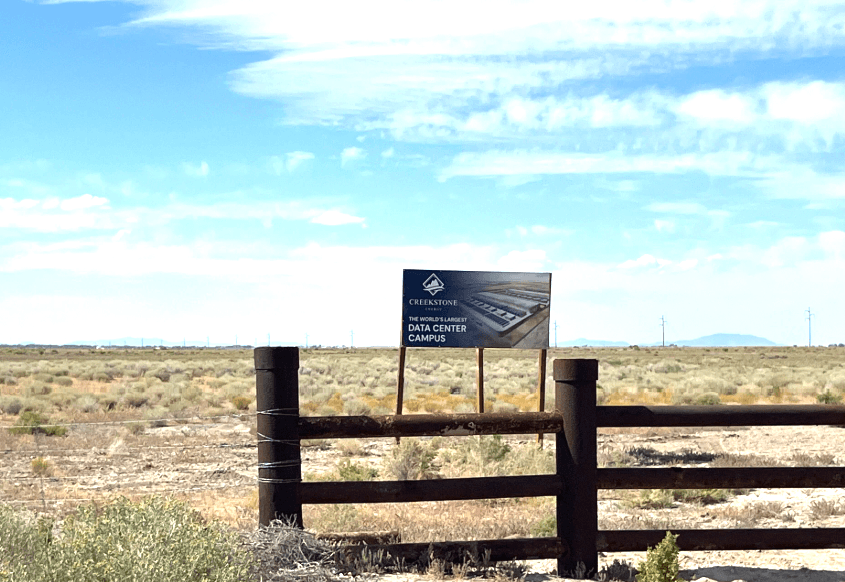
Nearby, Creekstone Energy has secured 43,000 dekatherms per day of firm gas transportation on Kern River. That supports about 220 megawatts of behind-the-meter generation for the first block of its Delta Gigasite. Creekstone envisions more than 10 gigawatts at the campus. Its contracted gas covers the first block.
Two lessons stand out.
First, the speed is real. Creekstone says its engine supplier can deliver equipment nine months after an order is placed. Modular engines can arrive far faster than a new transmission line can be built.
Second, the capacity that counts is the capacity with fuel, equipment and permits behind it. An announced gigawatt and a contracted megawatt are different numbers.
I am not predicting that either project will miss its dates. Both have done serious work to secure engines and fuel. My point is that every block of private power carries its own schedule.
Moving the risk is not removing it I do not see a villain in this story.
The utility has to protect existing customers. It cannot build generation and transmission on speculation and hand the bill to households if a campus never arrives.
The developer has a building it can finish in a few years and a customer who wants capacity on a date. Waiting for the shared system may not fit that date.
So the developer builds its own power. Each decision makes sense on its own.
Added together, they create a different problem. Power plants get planned campus by campus instead of system by system. Fuel demand concentrates on a few pipelines. The Gardner memo describes data center load as concentrated and non-interruptible, adding to peak demand without flexibility for curtailment. It also reports that the North American Electric Reliability Corporation projects Utah will face elevated grid risk in 2031.
That is the market failure. The fastest path for each project is not necessarily the most resilient path for the region.
Private power also brings its own obligations. It needs reliable fuel, air permits, trained operators and an answer for the day a unit trips. Under Utah’s law, a utility is not required to provide backup power to a covered large-load customer unless the contract says so.
Behind-the-meter power is not wrong. For some campuses, it is the only schedule that works. It moves the risk. It does not remove it.
Build the schedule from the power backward Most schedules start with land and move forward. I would start with the first usable megawatt and work backward.
When must the first block of power be available? What does the campus need on day one, and how quickly does the load grow after that?
Then name every milestone that controls the date:
The utility evaluation and written service proposal.
The executed service or generation contract.
Firm fuel transportation for any on-site generation.
Orders for engines, transformers, breakers and other long-lead equipment.
Air permits, construction, testing, commissioning and permission to operate.
Put the longest of those on the critical path. That is the real schedule, whatever the building line says.
Six questions before the first shovel Before a campus breaks ground in Utah, I want six answers:
How many megawatts are needed on day one, and how fast does the load ramp?
Which path supplies the first block: the utility, on-site generation or both?
What does the written utility proposal say about cost, upgrades and timing?
How much of the planned capacity has contracted fuel, reserved equipment and permits behind it?
What happens when a generating unit trips or fuel delivery is interrupted?
If one path slips, what happens to the campus and to the town around it?
In the desert, land is the easy part. Power sets the schedule.
In my next post, I will look at a different kind of firm power: the kind that comes from beneath Utah.
Build the schedule from the power backward, before anyone breaks ground.
Get a site-to-power schedule estimate Planning a data center or industrial campus in Utah? Ask Ber Wilson for a site-to-power schedule estimate.
Bring your site location, phased load profile, target energization date, any utility correspondence, fuel discussions and current equipment quotes. We will map the milestones between site control and usable power, identify which ones control the date and show where the schedule carries the most risk.
The estimate does not guarantee a service date. It shows you what has to happen to reach one.
Contact Ber Wilson info@berwilson.com