Data Centers and Rural Utah Communities | Ber Wilson
A Mona rancher learned about a data center from a pipeline request. Ber Wilson explains why the community has to come first, before the vote.
| By Ericson Tua'one
- DataCenters
- Communities
Data Centers Need Neighbors
Author: Ericson Tua’one September 23, 2026
In August, a gas company representative knocked on Taylor Flake’s door.
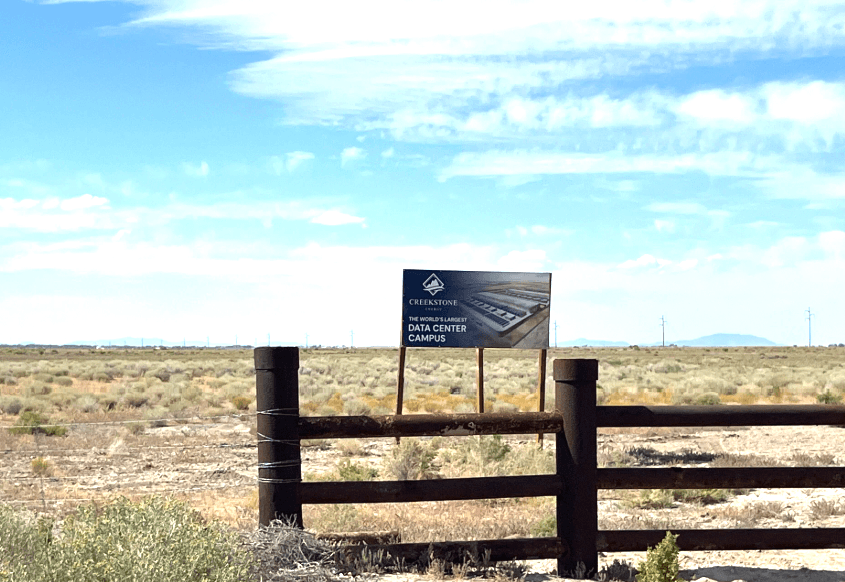
Flake owns a ranch outside Mona that he calls Far Away Ranch, named for its distance from anything else. The representative wanted permission to run a pipeline across his land. The pipeline would help power a data center campus planned directly across Goshen Road.
That was how Flake learned about it. The county planning commission had approved the project’s conditional use permit four months earlier.
Without that visit, he told The Salt Lake Tribune, he “would still be totally in the dark.”
On Tuesday, September 8, Flake and his neighbors gathered at the Mona City Center and drove in a procession to a Juab County Commission meeting at Rocky Ridge Town Hall. Some arrived on horseback, with American flags waving above them. Others carried signs that read “Give us a vote.” People lined the walls and spilled into the hallway, listening through the open doors.
“Tell us what’s being proposed,” Flake told the commissioners. “Give us a genuine opportunity to be heard before, not after, the decision is made.”
Following the law is not the same as being heard
The project is large. According to the permit application, it could include up to 10 single-story buildings. Together, they would be roughly the size of 20 typical Costco stores.
The approval was quick.
The county posted a hearing notice on its website on April 2. The planning commission approved the permit on April 15. The public hearing lasted four minutes. No one spoke against the project.
County Commissioner Clinton Painter said the county followed state law “to the letter.” He also acknowledged that data center proposals “came at us awfully quick.” “We’re not hiding things,” he told the crowd. The county is now working to schedule an informational meeting.
I take the commissioners at their word. Nothing in the reported record suggests anyone broke a rule.
That is exactly the problem. A project can meet every legal requirement and still arrive as a surprise to the people who will live beside it for decades. A website notice satisfies the code. It does not reach a rancher across the road.
Once the permit is issued, the conversation changes. As Flake put it, “all you’re doing is negotiating the impact.”
What the developer has said
The developer’s side deserves a fair hearing, too.
A development partner told the planning commission that the project would cover all needed infrastructure upgrades and pay higher electricity rates, keeping those costs from being passed on to existing customers. That is the protection Utah’s large-load law was written to require, as I covered in Who Pays for the Power? Developers also told the planning commission that the campus would bring well-paying jobs.
Other questions remain open. A representative said in March that power would come from the grid, but the permit indicates it could also come from on-site natural gas generation. The campus would cool its servers with a closed-loop system using water that is trucked in. The meeting minutes do not say where that water would come from.
As of early September, the developer had not yet submitted a site plan.
The same day, a different story
On September 14, the same day the Tribune story ran, Meta announced that it was expanding its Eagle Mountain data center.
Meta also described what it has put into that community since breaking ground in 2018. It has helped build roads and water infrastructure. It has supported local schools. It has funded mortgage assistance for local families.
Those are Meta’s own descriptions, and I present them that way. Eagle Mountain has also hosted Meta’s data center for years and has grown alongside it. Mona is a small pioneer town.
But the contrast teaches something. One project arrived with a public account of what it gives back. The other arrived, for its nearest neighbors, as a stranger at the door asking for an easement.
The town carries the impact
The costs of a data center are local. Neighbors in Mona worry about the rumble of construction equipment and the hum of cooling systems running day and night. Add pipelines across ranch land and water trucks on rural roads.
Mona resident Christine Miller asked the question many neighbors share: will there be enough water for data centers and for the people and livestock already there?
Much of the value travels. Tax revenue spreads across the county and other taxing entities. Profits go to owners and customers far from town. Whether the jobs go to people who already live in Mona depends on training and hiring commitments. The reported permit record does not describe any.
That is the market failure. When neighbors carry the burden and have no voice in the outcome, opposition is the rational response. It is not stubbornness. It is people protecting the place they love.
Utah is beginning to respond. The legislature has added water reporting for large new data centers and limits on local incentives. Box Elder and Iron counties adopted temporary moratoriums to give officials time to set rules.
Those are reasonable steps. None of them puts the town at the table.
The best deal for Mona
One Mona resident said something at that meeting that deserves more attention.
Dan Woodland told the commissioners he is not against all data centers. He opposes this one. But if the commissioners’ “hands are tied” on the permit, he asked them to negotiate with the developer and get the best possible deal for Mona.
That is the right question, asked too late.
Picture the same room, months earlier. The notice went to every landowner within a mile by mail. The developer stood at the front with a map, a power plan and a water plan. It answered the pipeline question before the gas company ever knocked.
Then it asked a different question: What does Mona need?
Maybe the answer is a stronger water system. Maybe it is a road that can carry trucks without wearing out. Maybe it is training that lets young people find good work without leaving home. Whatever the answer, the town gave it, and the developer wrote it down.
This is an imagined meeting. People in it might still say no. But they would be deciding about something they could see, on their own terms.
The community comes first
This is how I would approach a project like this one.
Start with the town, not the site plan. Before the drawings are final, meet the people who live there. Learn how their water works, which roads their kids travel to school and which families have worked that land for generations.
Go to the neighbors before the hearing, not after the permit. Explain the power and water plan in plain language. Let the town’s priorities shape what the project commits to. Put local hiring and training on paper. Write those commitments into agreements the town can enforce, not into press releases.
The community comes first because it was there first. It will still be there long after the last server is replaced.
I will not claim that this approach makes every project welcome. Some sites are wrong for a data center, and some towns will say no. That is their right.
What a community-first approach does is change the question. It moves the conversation from “How do we stop this?” to “What would make this good for us?”
Six questions before the vote
Before a data center comes before a county commission, I want six answers:
- Who lives near the site, and how will each of them hear about it before the hearing?
- What does the town need most, and who asked the people who live there?
- Where will the power and water come from, and whose land will lines and pipelines cross?
- Which local residents will be trained and hired, and for which jobs?
- What has the project committed in writing to the town’s roads, water and schools?
- What will the town have in 20 years that it does not have today?
A data center will sit in a town for decades.
The neighbors should hear about it before the gas company knocks.
In my next post, I will look at who builds projects like these, and whether those jobs stay in the towns that host them.
Plan a community-first project
If you are a county commissioner, city leader or investor weighing a large project in a rural community, ask Ber Wilson for a community partnership walkthrough.
Bring the site, the project plan and the community you want to work with. We will walk through how early notice, listening sessions, local hiring and written commitments can be built into the project before the first hearing, and what each one requires from the developer and the town.
The walkthrough does not replace legal or financial advice. It shows you what putting the community first looks like in practice.