Nuclear Projects Are Won Between Contracts | Ber Wilson
X-energy’s Cascade project assigned a team to integrate requirements across the plant. Ber Wilson on why the space between contracts decides advanced nuclear projects, and what Utah should do about it.
| By Ericson Tua'one
- Power
- Nuclear
- Utah
Won or Lost Between Contracts
Advanced nuclear is coming. The projects that succeed will be the ones that plan the work between the contractors.
Author: Ericson Tua’one, Chief Executive | Ber Wilson
Published: November 6, 2026
The most important sentence in American nuclear energy this week was not about a reactor.
It was five words about responsibility.
On Thursday, X-energy announced that it had selected Fluor to engineer the nuclear island at the Cascade Advanced Energy Facility near Richland, Washington. In the same announcement, X-energy noted that a second team, Cascade Nuclear Partners, is the design-builder for the conventional island and is responsible for “integrating requirements across the plant.”
Integrating requirements across the plant. On most projects, nobody is given that job.
Every builder knows what that job protects. Look at Kemmerer, Wyoming. TerraPower began full-scale construction there in April, after the Nuclear Regulatory Commission issued the construction permit for its advanced reactor. The company expects about 1,600 construction workers on site at peak.
On any given morning, those workers depend on things no single contract fully owns. The road has to carry the load. The trailers need power. The pad has to drain. The steel has to arrive in the order it goes up. A superintendent knows every one of those details by heart. An owner usually learns about them the day one of them stops the work.
The reactor gets the headlines. The project is won or lost between the contracts.
The Industry Said It Out Loud
What I respect about the Cascade announcement is that X-energy did not bury the problem. Among the factors it says could change the outcome, the release lists “challenges in coordinating work among multiple contractors.”
That is a company telling the public where the risk lives. The teams willing to say it plainly are the teams I would trust to manage it.
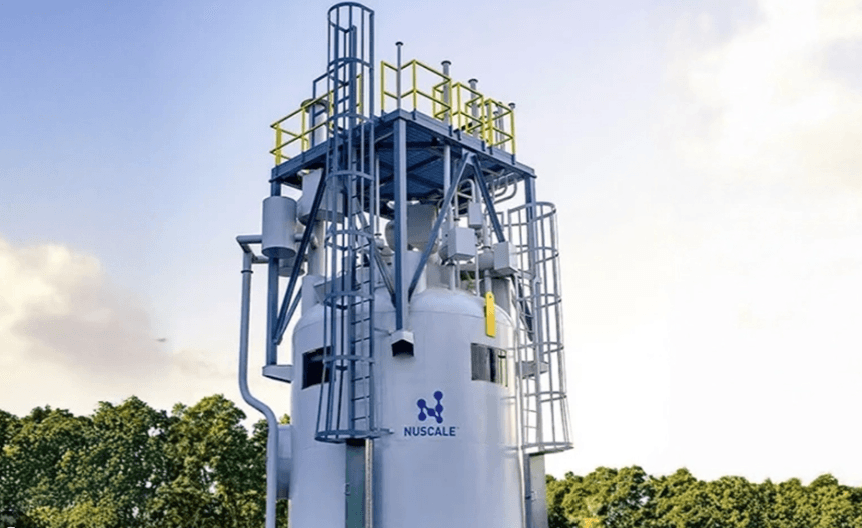
The scale is real. Each Xe-100 reactor produces 80 megawatts, and X-energy builds them in four-unit or twelve-unit plants. Cascade is the first project in X-energy’s partnership with Amazon, which aims to deploy 5 gigawatts of new nuclear power by 2039.
There is another line in that release every Utah builder should read twice. X-energy says its design keeps the safety-related systems together in the nuclear island, so the vast majority of the conventional island and balance-of-plant systems can use commercial, off-the-shelf components from the broader industrial supply chain. The company is careful to note that this depends on the NRC accepting how those systems are classified.
If that holds, much of the work on an advanced nuclear campus will be work that experienced industrial builders already know how to do. That is a national opportunity, and Utah should take a serious share of it.
Utah Has Earned a Serious Look
In July, the U.S. Department of Energy named Utah one of five initial contenders to host a Nuclear Lifecycle Innovation Campus. The department reviewed 28 applications from 26 states. Utah was selected alongside Tennessee, Oklahoma, Louisiana, and Idaho.
DOE estimates a campus could attract up to $50 billion in capital investment, generate as much as $10 billion in state and local tax revenue, and create nearly 25,000 jobs. Those are federal estimates for a program still in its early stage. They are reason enough to get ready.
Governor Cox described what is at stake when the selection was announced. Utah, he said, is developing the entire nuclear lifecycle, “strengthening our national security while helping secure America's energy independence.” I agree with him. Energy we build here is energy no one else controls.
The business case is already here. According to the Governor’s Office of Economic Opportunity, WalletHub ranked Utah’s economy third in the nation in June 2026, and CNBC named Utah the cheapest state to start a business in March 2025. Operation Gigawatt, announced by Governor Cox in October 2024, commits the state to doubling its power production within ten years, with nuclear and geothermal development among its priorities.
A state does not win this kind of work by saying it wants it. It wins by showing that projects here get built the way they were promised.
Every Good Project Starts With the Job
At Dow’s Seadrift Operations on the Texas Gulf Coast, the proposed Long Mott Generating Station has a clear job. Four Xe-100 reactors would deliver 320 megawatts of electricity and process steam to a working chemical plant, with any surplus power going to the grid.
In October, NRC staff completed the final safety evaluation for the construction permit and recommended that the Commission make the findings needed to issue it. The NRC’s Advisory Committee on Reactor Safeguards sent its independent review to the Commission on October 16. The permit decision now belongs to the Commission.
Here is what caught my attention. When Fluor signed its first Long Mott contract in April, the work was front-end planning: project definition, strategic planning, feasibility assessment, cost control, and risk mitigation. Before anyone could build the plant, someone had to define the job.
That is the lesson I would bring to every campus in Utah. Start with what the customer needs to do. What does the facility have to produce? When does it have to run? What belongs in the first phase? Answer those questions honestly, and the energy, building, and infrastructure decisions become much clearer.
The First Meeting and the Ribbon Cutting
Every project has a first meeting where the builder sounds certain about everything. The dates are firm. The budget is solid. The risks are handled.
Then the utility moves its service date. The switchgear slips a quarter. A decision three teams were waiting on sits on one desk for a month. The builder was certain about things it never controlled.
The builder worth hiring sounds different in that first meeting. It tells you which dates it owns and which dates it is chasing.
- Control: We direct the work, and we answer for the result.
- Coordination: We manage the handoff, and the contract says who carries the risk.
- Contingency: The plan depends on something still unresolved. We name it and tell you what happens if it changes.
Then that builder does something harder. It works to move the most dangerous dates out of the second and third lists and into the first.
That builder may sound less impressive in the first meeting. It will look far better at the ribbon cutting.
A Utah Proposal to Watch
Near Price, Valar Atomics has proposed Project Beehive, a nuclear-powered industrial and data center campus. NPR reported that company documents describe about 456 reactors and roughly 9.6 gigawatts across more than 9,000 acres of federal land. Those are full-buildout figures in a proposal, not approved capacity.
The Utah Trust Lands Administration approved a Valar lease proposal in September. That is a state land decision, separate from any authorization to build or operate reactors. According to the American Nuclear Society, Valar told NPR that “no construction begins before permits and approvals,” and NPR reports the company aims to begin nonnuclear construction by the end of this year.
When nonnuclear construction begins, on Beehive or any campus like it, it will be builders’ work: site preparation, roads, utilities, and buildings. Utah’s construction and manufacturing base should be ready for it.
For a proposal of any size, I would ask five questions:
- Who is the first customer?
- What must the first phase deliver?
- What must be approved and procured before it can operate?
- Who owns each connection?
- What evidence justifies the next phase?
These questions are not a test for one company. They are questions every serious team should be glad to answer.
Back to Kemmerer: Why Ber Wilson
Go back to those mornings in Kemmerer. The road, the power, the pad, the steel.
Ber Wilson was built to own them.
We are a developer operating as an EPC defense contractor platform. Ber Wilson Development finds and assembles sites, permits, and capital, so we start projects instead of waiting to be hired onto them.
Ber Wilson Steel makes the structure in our own plant in the United States, engineered to the project’s loads and delivered in erection sequence. Because we manufacture the steel instead of buying it, we set the ship dates instead of waiting on a supplier. Our infrastructure crews build the roads, water and sewer lines, stormwater systems, power lines, and heavy civil work around the facility.
Power is the date most builders cannot control. Utility interconnection studies and long lead times for switchgear and transformers sit outside a conventional contractor’s reach. Where a project allows it, Ber Wilson Energy generates power at the point of load, which puts that dependency inside the contract of the party responsible for the schedule. Ber Wilson Energy also offers microgrids and small modular reactor solutions planned alongside the facility, not after it.
The steel date is one we control. We built this company so that more of the dates that matter would be.
For the scope we contract, the owner gets one contract and one point of responsibility for the schedule, the budget, and the finished facility. Where we bring in partners, we stay accountable for the result. Reactor design, licensing, and nuclear safety stay with the qualified organizations responsible for them. We connect cleanly to their work, and we own ours completely.
Value That Stays Local
Kemmerer’s numbers tell a community something useful. TerraPower expects about 1,600 jobs at the peak of construction and about 250 permanent jobs once the plant is running. Both matter. They are different opportunities on different timelines, and people deserve to know which is which.
Our plans are designed to hire locally and train people in the trades, and we listen to the community before plans are final. On every project, we want local firms to see which work packages they can pursue and what those packages require, early enough to prepare.
The community comes first when people can see the work and see a way into it.
Trust You Can Check
Trust is not something a company announces. It is something an owner checks.
So check us.
A date we give is a date we can hold. We would rather quote you an honest schedule than a convenient one.
In our first meeting, we will show you which parts of your schedule we control, which we will coordinate, and which still depend on someone else. Then we will show you which of those outside dates we can bring inside the contract.
Our estimates are built from quantities and production rates, and every option to speed up the schedule comes with its cost attached. You will see what the price depends on before you sign.
When something goes wrong, the name on the fix is ours.
I am asking every developer and builder chasing this work to meet that standard. Hold Ber Wilson to it first.
The reactor will get the headlines. We want to be the reason it opens on time.
In my next post, I will look at how the factory and the grid fit together, and why the plant that builds the town can also help power it.
Define Your Project With Ber Wilson
If you are an owner, developer, or industrial customer planning a campus, a data center, or a manufacturing facility, bring us the business objective, what you know about the site, and the date you need it running.
You do not need finished requirements. Defining them is where we start. We will come back with the scope, the budget, and a delivery window, and we respond within one business day.
Start a Project · Contact Ber Wilson · Call 385-436-5507
Ericson Tua’one is Chief Executive of Ber Wilson, a developer operating as an EPC defense contractor platform headquartered in Salt Lake City, Utah.
Keep Reading
- The Factory Builds the Town (October 7, 2026)